When Mayor Zohran Mamdani showed up in the Oval Office with his trademark grin and a fake Daily News cover reading “Trump to City: Let’s Build,” he was playing to the president’s roots in Queens real estate. Mamdani dangled a rare pearl of a project that would allow Trump to leave his thumbprint on his native borough: Sunnyside Yard. That long-dormant plan would build out one of New York’s last great empty swaths — more than six times bigger than Hudson Yards and three times the size of the rail yards that Trump acquired in the 1980s to erect what became Riverside South. If the developer-in-chief still dreams of putting up a Trump City sign on a big chunk of New York, Sunnyside Yard is where he could do it.
Trump has been snapping up opportunities to control — and in some cases quash — megaprojects in his hometown. Last October, his transportation department froze $16 billion that the Biden Administration had allocated to Gateway, the intricate complex of tracks, bridges, and a new Hudson River tunnel intended to improve rail service between New Jersey and Manhattan. Work stopped last month, crews were laid off, and job sites closed. A federal judge ruled that the government couldn’t withhold money that had already been committed, so the workers are now being rehired and boring can begin again. But the project remains on probation, at least until the appeals courts — and possibly the Supreme Court — finally resolve the dispute. At the same time, the MTA is suing the government to force it to release funds that may stop the Second Avenue Subway project, too.
On another front, though, the Trump administration is chugging ahead. In less than nine months, the federal Department of Transportation took control of the Penn Station renovation, put out a call for design and development teams, and selected three finalists. It has promised to pick one by June. And in case there’s any doubt how closely the president is watching, he’s reportedly eager to rename the station for himself. At the same time, he’s jumping back into the hospitality business, dragooning the government into partnering with Pakistan to redevelop the defunct but still hugely valuable Roosevelt Hotel.
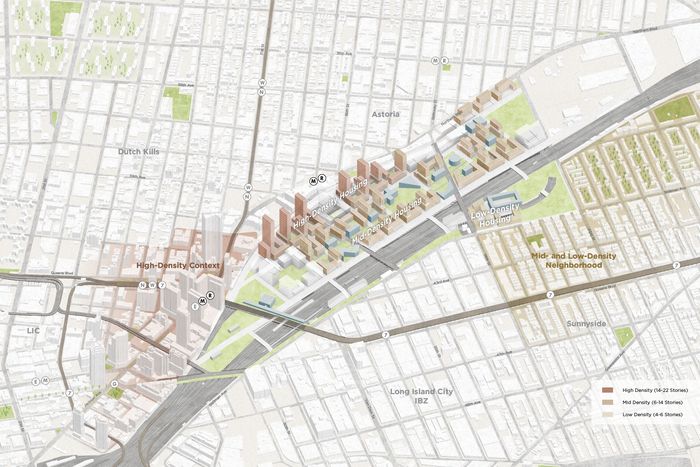
A diagram of Sunnyside Yard from 2020.
Photo: PAU
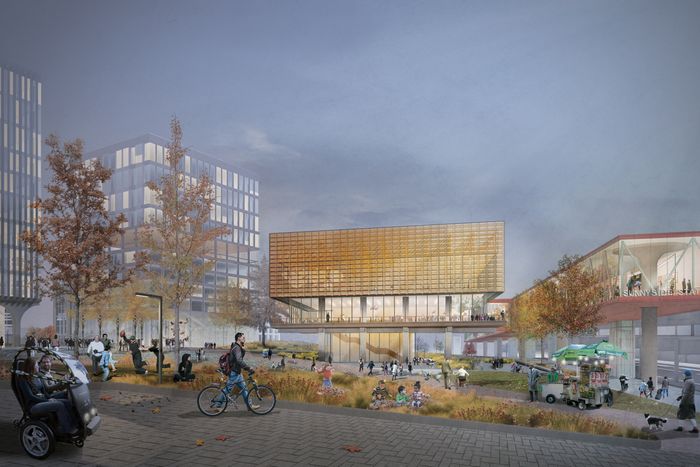
Sunnyside Yard is envisioned to have a large transit hub and walkable streets.
Photo: Practice for Architecture & Urbanism
As Mamdani surely made clear to his new White House frenemy, Sunnyside Yard has all the ingredients that Trump could wish for. The project involves building a massive platform over the sunken tracks, which will require substantial federal funding. Amtrak owns much of the railyard, and the government effectively owns Amtrak, which means the president can largely set the terms. And at a time when Trump’s policies are undermining Trump’s promise to deliver more new housing — since tariffs raise the cost of building materials and ICE raids on construction sites winnow construction crews — this project alone could create 12,000 new apartments. It’s rich with opportunities for glory.
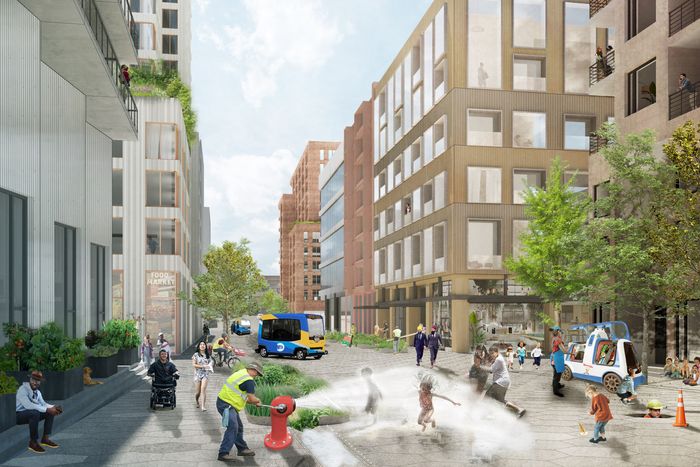
Photo: PAU
It’s also a good idea, and was long before Trump got involved. More than a decade ago, the de Blasio administration hired the architecture firm PAU to design a neighborhood over the railyard, with new streets and a new regional transit hub, like a Queens mini–Penn Station. PAU proposed something far more nuanced than just a dense collection of apartment towers: Their plan envisioned a network of elevated open spaces — courtyards, parks, plazas, and pedestrian-friendly streets organized around a central spine. Unfortunately, the plan came out in early 2020 just as the pandemic hit. The MTA, overwhelmed with other priorities (including its plans to rebuild Penn Station and extend the Second Avenue Subway), wasn’t interested in a new Sunnyside station. Bill de Blasio ran out of time to push the project through public approvals, and his successor, Eric Adams, expressed zero interest in reviving it. So the project is still sitting there, a big site bundled with an even bigger idea, waiting for a couple of politicians with compatible styles and mutually reinforcing housing agendas to kick it back to life.
Sign Up for the Curbed Newsletter
A daily mix of stories about cities, city life, and our always evolving neighborhoods and skylines.
Vox Media, LLC Terms and Privacy Notice