


A rendering of what Spence had hoped it could build as part of its lower school’s expansion along Madison Avenue.
Photo: NYC Landmarks Preservation Commission
The Spence School had a problem: For more than 20 years, the all-girls private school had housed its youngest students at the William Goadby Loew House on East 93rd Street, and things were feeling cramped. In January 2025, the school purchased a $10 million building comprising a pair of rowhouses around the corner in Carnegie Hill’s historic district, at 1307-09 Madison Avenue, and last month, Spence came to the local community board’s landmarks committee to present its expansion plans. In addition to connecting the lower school with the rowhouses, the architects wanted to raise the cornice line on the Madison Avenue building and add a story, plus install new geothermal equipment and a ball cage that would extend another 20 feet above the new roof.
Plenty of neighbors, as you might expect, were outraged by the prospect of this bulky mass looming over a historically low-scale swath of streetscape, the 11-story condo building that’s one storefront over notwithstanding. They were also resigned to the likelihood that they would get steamrolled. “I feel like so much is happening everywhere in the city, including in this neighborhood, where it’s just ‘money talks,’” Hélène M. de Barcza, a neighborhood resident, told me. This seemed to be the case when the community board’s landmarks committee voted against recommending the Madison Avenue renovations to the city’s Landmarks Preservation Commission, only for the full board to side with Spence a couple of days later. But it appears that having Anna Wintour and Michael Bloomberg’s daughters as well as Gwyneth Paltrow in your alumni Rolodex doesn’t guarantee a frictionless path to approval: Landmarks commissioners, who have the final say on the matter, didn’t issue a decision at Spence’s public hearing on July 28. To those in the know, this was the commissioners’ polite way of saying “try again” — a result that feels, if not quite David toppling Goliath, like a significant blow to an extremely deep-pocketed giant. “I don’t think we could have asked for anything better than what we got in terms of the commission’s reaction,” Lo van der Valk, president of the local preservation group Carnegie Hill Neighbors, tells me.

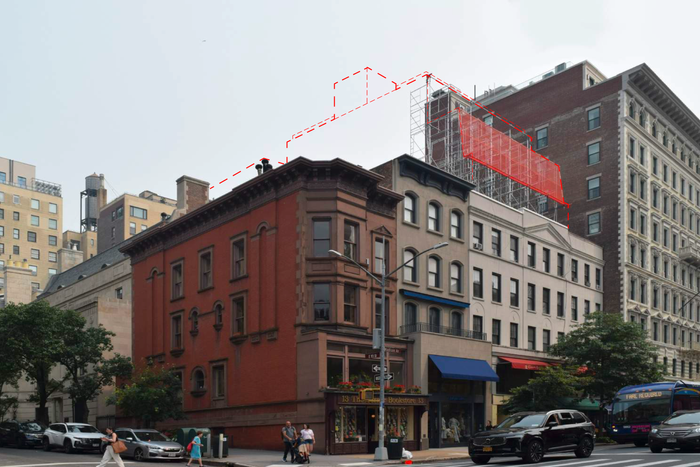
Spence had hoped to install a ball cage and equipment for a new geothermal system on top of the Madison Avenue rowhouses.
Photo: NYC Landmarks Preservation Commission
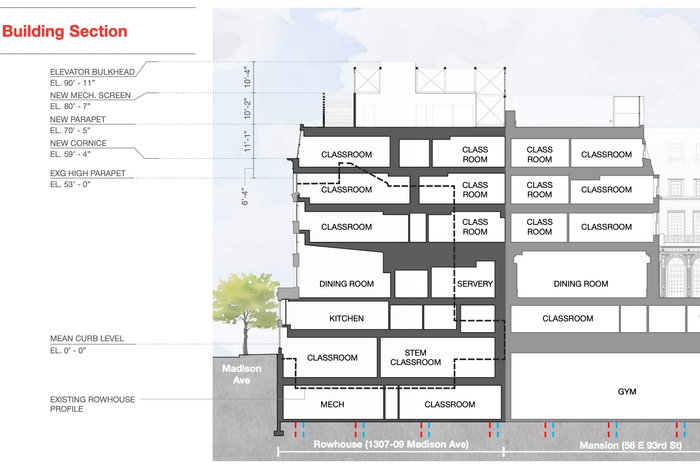
Spence wants to do a gut renovation on Madison Avenue to add nine additional classrooms, including a full-size STEM lab and a larger kitchen.
Photo: NYC Landmarks Preservation Commission
The school currently operates out of three buildings on the Upper East Side: its upper and middle school on 91st Street, the lower school on 93rd, and a six-story athletic and educational center on 90th, opened in 2021, that includes nine squash courts, a rooftop garden, a greenhouse, and kitchen. Over the past several weeks, Spence repeatedly laid out its case for expanding the Madison Avenue buildings to neighbors and officials alike. The reasons included some that felt understandable, like the assertion that more outdoor space would be good for the students, and others that perhaps felt a little performative — that grade-schoolers these days apparently need a proper, full-size STEM lab. (God forbid the students should have to test their robots in the “beautiful Loew lobby,” as Spence’s head of school, Felicia Wilks, recently griped.) Although the student population has only grown by five since 2019, the administration is also looking for a way to bring its fifth-graders to the lower school from the middle school on East 91st Street, since fifth is technically an elementary-level grade (limited space at the Loew mansion had forced Spence to keep fifth-graders at East 91st Street when it purchased the building). Diagrams and schematics for the Madison Avenue project by the firm MBB showed a gut renovation of the rowhouses and expanded floor plates to create an additional nine classrooms, along with a larger cafeteria and kitchen. “Right now some of our students eat lunch at 10:45 in the morning because we don’t have enough dining space,” Eric Zahler, Spence’s director of teaching and learning, said at the community board’s committee meeting. On top of the nearly 40-foot vertical expansion of the rowhouses, the plans also included adding a play deck on top of the lower school’s roof. “Buildings don’t educate children, teachers do,” Zahler said. “But the spaces that we provide for that learning really matter.”
It’s fair to assume that parents paying $71,000 a year would prefer their 9-year-olds testing out their robot dogs in a fully equipped lab instead of on the lobby floors and playing kickball somewhere nicer than a terrace that looks like a glorified dog run. But those outside the Spence community feel that they would lose — and have already lost — something significant. For one, the double-wide ground-floor retail space of the Madison Avenue building was occupied for decades by Patrick Murphy’s, a well-liked grocery store where people could charge a liter of Pellegrino and a pint of ice cream to a house account. The owner announced months after the sale that she was closing and now it’s clear that the retail space will vanish, giving way to an institutional ground-floor on what’s otherwise a shopping strip. “Nothing retail ever survives in front of Hunter High School because it’s dark and dismal,” Bill Brothers, a member of the neighborhood group CIVITAS, told me, referring to a campus just one block north of Spence. “If you take out this block, it’s going to ruin it.” (What would he put instead? Anything that would retain some pedestrian activity: “I don’t care if they put Spence merch in there,” he said.) There is also just some old-style New York crankiness here. One neighborhood resident complained during a community-board meeting (from, apparently, under her bedcovers) about having to deal with the sound of the kids shouting at recess. Then there was Helene Golay, an 86-year-old who has lived at the end of the block above her shop, the Corner Bookstore, since she purchased the building in 1976. She fears that years of construction mess would put her business at risk. “It’s going to be an absolute mess,” she told me. “You can imagine the cranes. You can imagine the scaffolding. You can imagine the equipment.”
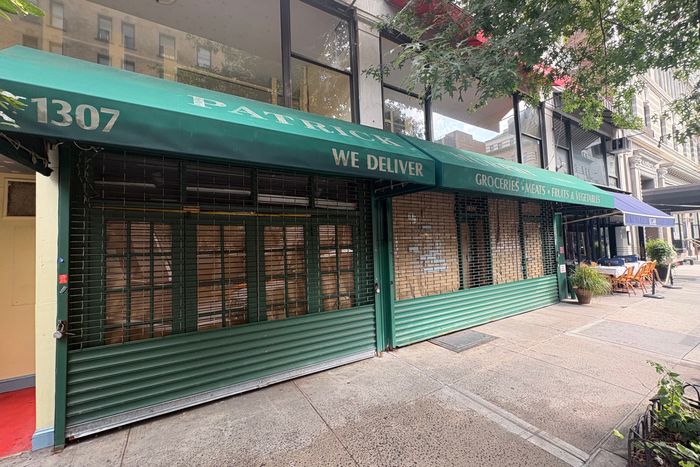
For decades, locals shopped at the now-shuttered grocery store that was located in the ground-floor retail space of 1307 Madison Avenue.
Photo: Matthew Sedacca
There’s also a simple question of the locals’ more traditionalist architectural taste. Jeffrey Brodlieb, a resident in the neighboring rowhouse at 1305, bemoaned during the Landmarks hearing that Spence would remove a handsome pediment that currently stretches across the façades of all three rowhouses in order to bring more daylight in the classrooms. “It’s been there for nearly a hundred years; it’s part of the neighborhood,” he said of the pediment. “It has historic fabric.” Then there are the vertical additions —the new cornice and parapet, sure, but also the ball cage and mechanical equipment covered by a bronze screen, all of which critics characterized to me as “absolutely horrific,” “looking like a downtown building,” and “just butt-ugly.”
Spence is not alone in its ambitions. Its drive for an expanded campus is part of an ongoing arms race among private schools across the city. “Parents want the resources of a college campus delivered to a 12-year-old,” Emily Glickman, an educational consultant, tells me. “The baseline of a building with teachers and students and blackboard is over.” That means schools are gobbling up real estate for bigger and larger projects to enhance the product and appeal to parents. (It mirrors the college arms race that has turned Morningside Heights and central Greenwich Village into, respectively, Columbiatown and NYU-ville.) One neighborhood over, in East Harlem, the Nightingale-Bamford School broke ground last year on a 64,000-square-foot, three-story athletic center that will have not only an indoor turf field but also a Pilates studios. Marymount just a few years ago put up a new ten-story, 155,000-square-foot building on East 97th Street for its upper campus, full of STEAM classrooms, a FabLab, and sports and dining facilities. The all-boys Browning School recently turned a former Hertz garage on East 64th Street into a 60,000-square-foot high school that also houses its new gym. There was, unshockingly, grumbling around several of these expansions, too. “The addition of the moment seems to be the greenhouse — next it’ll be a heliport,” one community board member said back in 2013, when Dalton pitched a $24 million, two-story expansion with a glass enclosure for STEM initiatives.
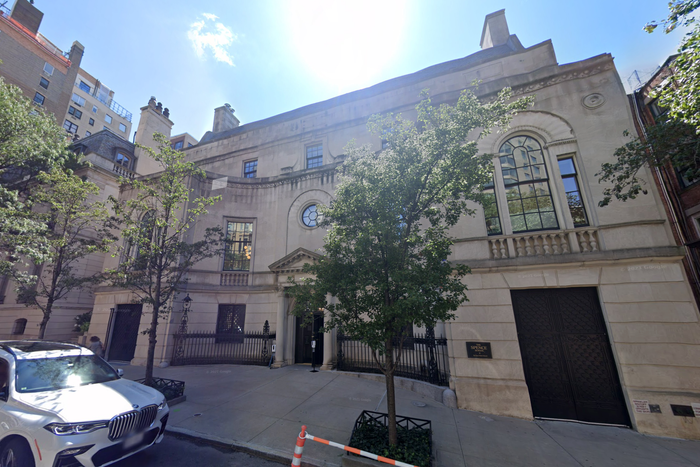
Spence purchased the William Goadby Loew House, an English Regency-style mansion that once operated as an alcohol-rehab center, back in 1999 for its lower school.
Photo: Google Maps
For Spence, running up against the neighborhood and Landmarks’ opposition isn’t unfamiliar. After purchasing the Loew mansion in 1999, Spence went before the commission eight times seeking approval of its expansion plans, eventually reaching a compromise that eliminated a sixth-floor addition to the five-story building. (Woody Allen, who had just moved to the neighborhood and fallen in with the local preservationist crowd, testified at at least three of those hearings against Spence’s pitch.) In 2011, after the community board and Landmarks greenlit Spence’s erecting a 33-foot-tall glass enclosure to connect its East 91st Street campus with an adjacent building, neighbors took their complaints to press. “They have tons of money, tons of power in the city. And it’s hard to fight them,” one neighbor told the New York Observer. Even a local Catholic priest launched a holy war against the school over its new athletic facility.
This time, during the hours-long Landmarks hearing, many of the commissioners seemed to come down on the side of the local opposition, particularly over the size of the vertical additions. “It’s honestly just much too overwhelming to the existing buildings,” one of the commissioners said. (In Landmarks-speak, this apparently was quite the burn: “Their tone is very polite, but the substance of what they’re saying is devastating,” Van der Valk, who testified at the commission’s public session and has opined frequently on the school’s various renovations over the decades, told me.) A Spence spokeswoman said the Madison Avenue building is a “rare option for potential growth,” and the school is still focused on a plan that “strengthens Spence’s future and ensures the school remains a trusted and valued community partner.” For Van der Valk, it’s hard to imagine what Spence is going to try to bring back to the table. “The school is not going to yield easily,” he said recently. “It’s going to be a tug-of-war.”
Sign Up for the Curbed Newsletter
A daily mix of stories about cities, city life, and our always evolving neighborhoods and skylines.
Vox Media, LLC Terms and Privacy Notice