Why this matters: Addressing California’s need for new housing units is dependent on the trends in household formations. Spanning new construction, resales, leasing or mortgage funding, the rise of one-person households causes ripple effects that agents and brokers need to adapt to and face.
Living alone dominoes into more sales and rental transactions
All by yourself? You’re in fine company. In fact, singles make up one-in-four households in California, up sharply from just a decade ago when singles consisted of one-in-five households.
This quick shift in singles’ attitude about sharing housing has multiple causes. For younger singles there are:
better educational levels;higher skill levels; andabove average wages.
For the elderly single homeowner, the causes include:
Prop 13’s annual lagging assessment increase at 40% of the increase in FMV;reverse mortgage income;support system surveillance equipment; andan individual’s subjective comfort zone.
All these factors contribute to more people living alone at different ages.
The percentage of households with a married couple is down from 51% in 2000. As of 2024, 48% of adults in California households include a married couple. One small cause is the rise of nonmarried couples living together – and blended families – reaching 8% of households in 2024.
This slight rise in general couples is offset by the rise of one-person households.
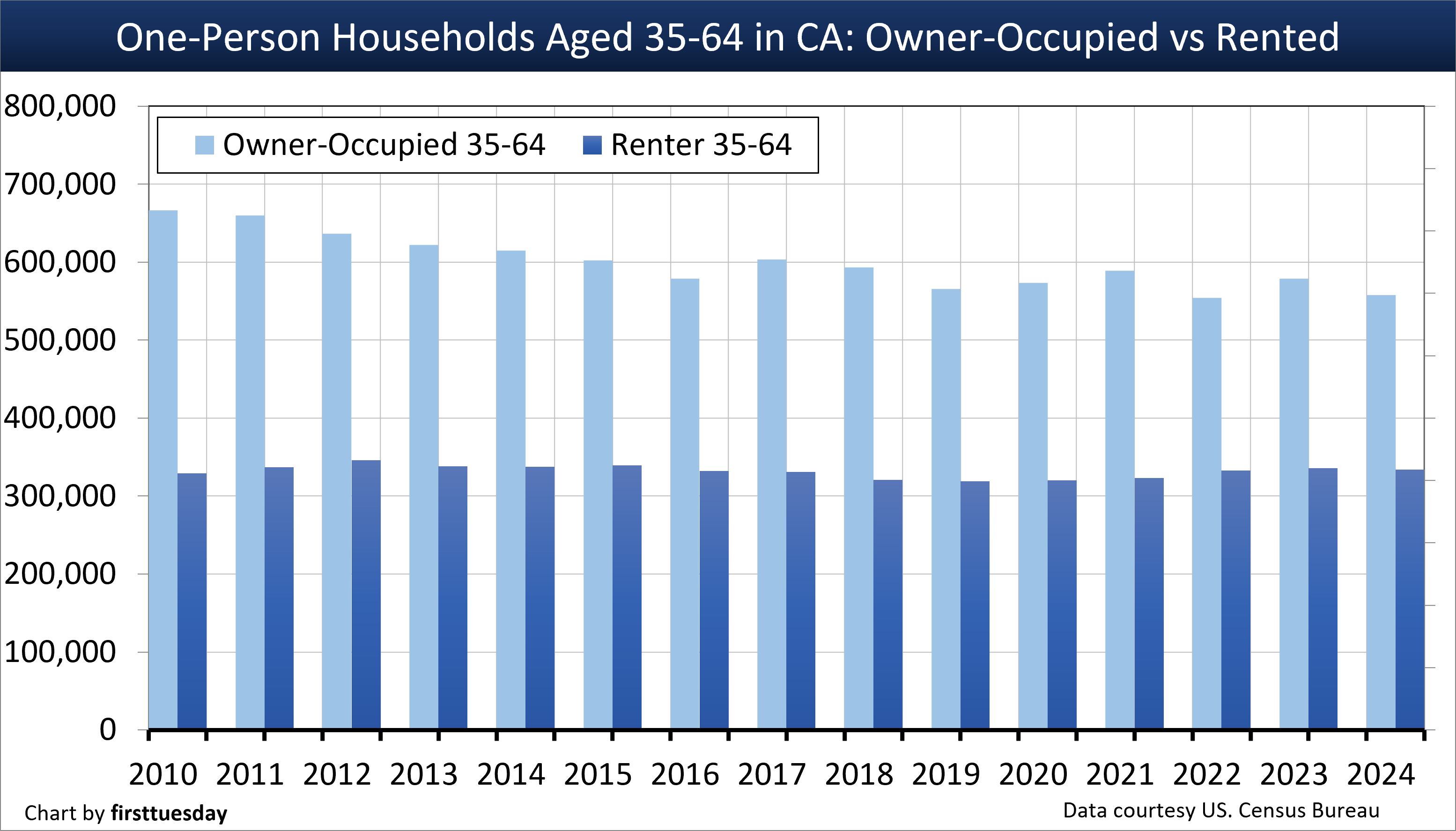
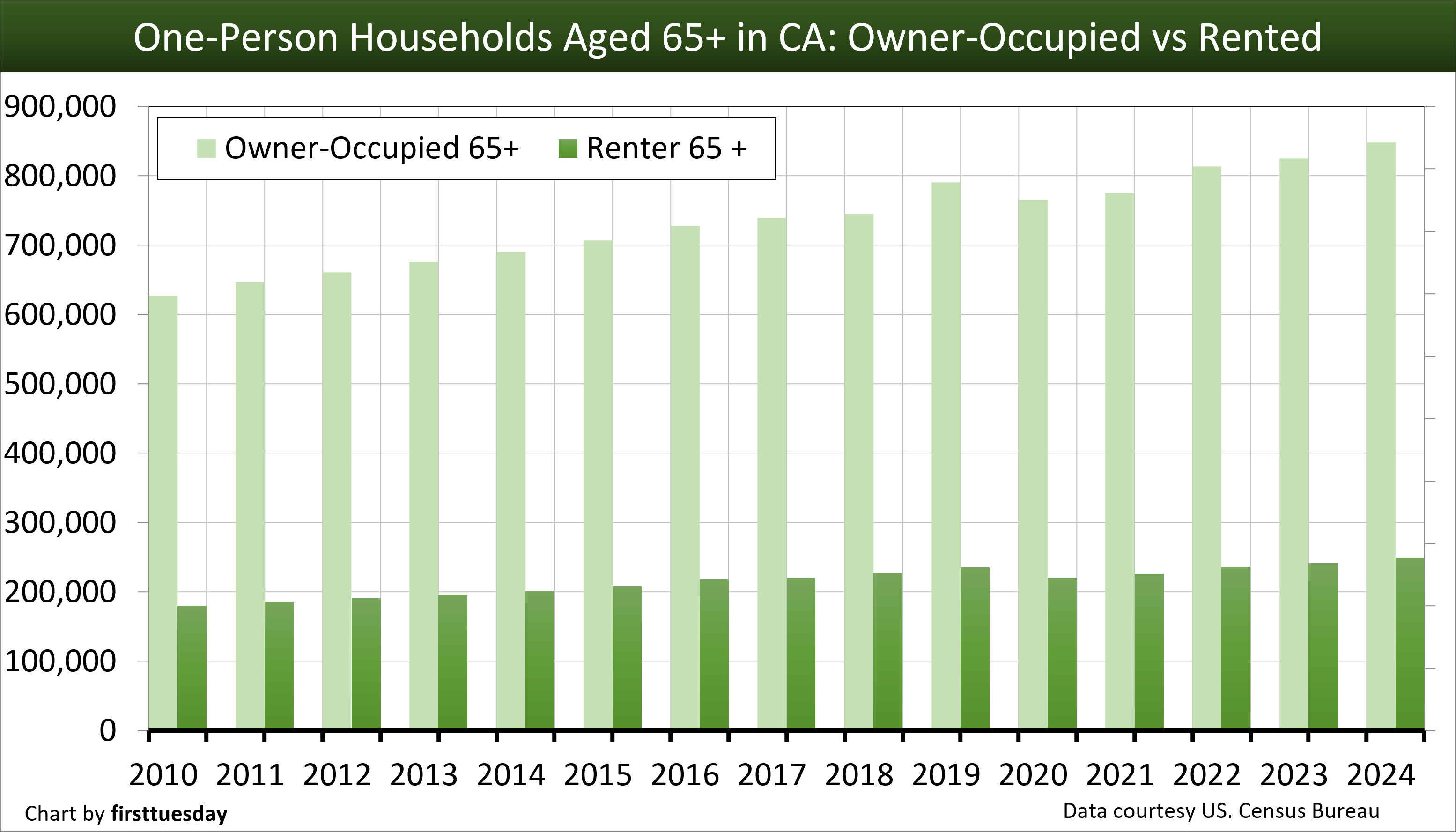
When broken down by age, single owner-occupants over the age of sixty-five show a steadily increasing growth since 2010. The inverse is true for owner-occupants in the typical homeownership age range of 35- to 64-years-old.
With the large Boomer generation holding onto their properties even as they live alone, housing turnover is now screeching to a halt. Further reducing necessary turnover, households desperately hold onto lower mortgage rates from the past rather than relocate and jump into today’s high cost for mortgage funds.
In California, the number of owner-occupants living alone over the age of 65 was 627,500 in 2010 — below the rate of those 35- to 64-years old. By 2024, the number had ballooned to 848,400, while one-person households aged 35 to 64 fell by 16% and those 15 to 34 dropped 6.5%.
These significant drops are echoed in the renter market. Tenant occupancy experienced a notable decline in average household size since 2014. The preceding Great Recession initially brought on increased household consolidation as renters tried to save money by cutting housing costs.
Updated August 14, 2026.
Chart 1
Chart update 8/14/26
2024
2023
Annual change
Renter-occupied household size
2.63
2.62
+0.38%
Owner-occupied household size
2.92
2.9
+0.68%
Single homeowners transactions are rising
It’s easy to assume one-person households are renters. However, increasingly more single tenants are striking out on their own to become homeowners.
Who are these single homebuyers? Most of them are women. Nationally by 2025, a full 25% of first-time homebuyers were single women compared to 10% single men, according to the National Association of Realtors. In 1985, the gender gap was a lot smaller with 11% and 9% of single women and single men buying a home respectively.
When looking at California marriage data in 2020, just over 45% of women over the age of 15 are married, according to Census estimates. However, a slightly higher 48% of men over age 15 are married. Most significantly, the marriage rate has leveled out for both genders. In 2010, 46% of women and 48% of men over the age of 15 were married.
Chart 2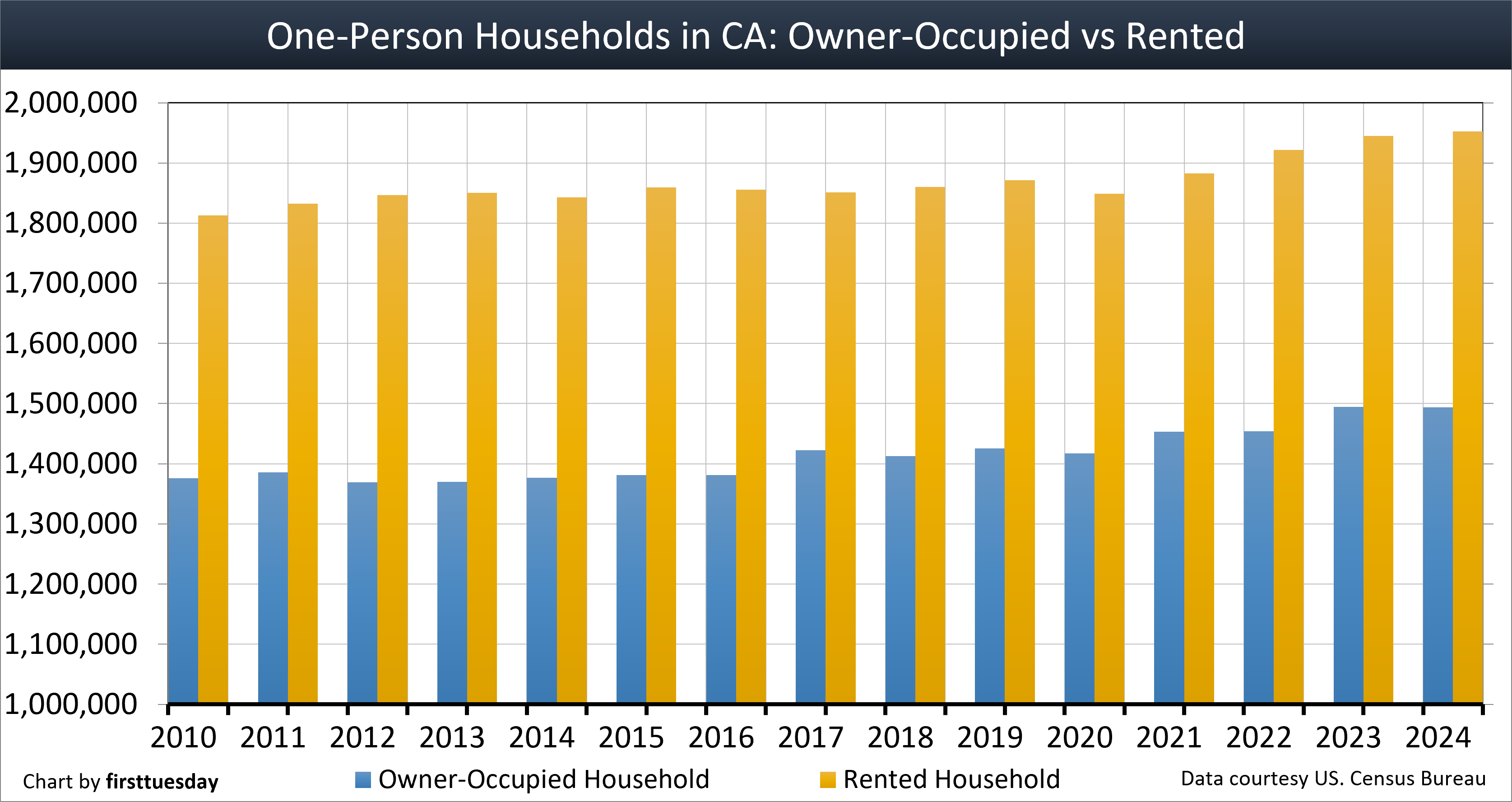

2024
2014
10-year change
Renter-occupied one-person household size in CA
1,904,938
1,685,545
+13%
Owner-occupied one-person household size in CA
1,493,664
1,376,955
+8.5%
Some will buy, more will rent
Homebuyers are looking a bit more mature lately. While some eager homebuyers choose to skip marriage and become homeowners, most remain renters in the interim.
After all, renting is often more affordable than buying in cities, especially cities where restrictive zoning and limited supply puts home prices out of reach for most young singles. Of course, rental prices eventually fall into line with growth in local incomes. In the meantime, renting means a steady homeownership rate, which stands at 55.7% statewide as of Q1 2026.
The question remains, where is the room for the generations once they are done waiting? The Millennial generation dealt with both the Great Recession and the Covid pandemic during their peak homebuying-age.
But even as jobs and wages caught up, rental rates and lack of savings during the financially fraught 2010s stacked against a potential buyer securing enough mortgage funding to tackle high prices.
But while Millennials and the younger Gen Z (born post-1995) might be renting now, their home purchases are coming once home pricing dips into an acceptable range allowed by mortgage rates and their household income.
Chart 3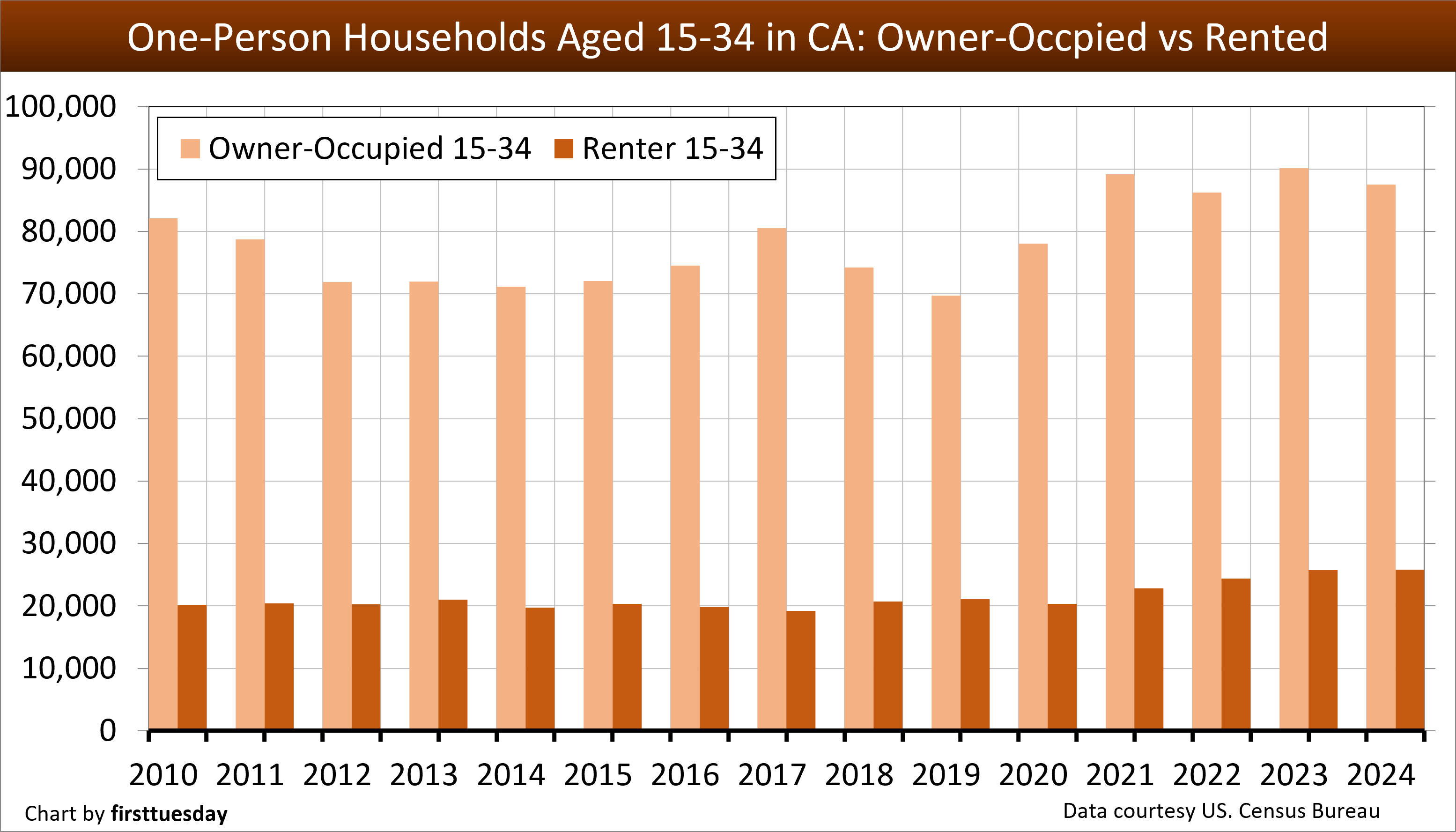


Smaller homes, lower prices
The demographic shift to single occupancy carries a transformation for marketing housing. Foremost is the need for less space. Single-person households don’t require the sprawling suburban homes made popular by the romanticized (and outdated) American Dream.
Second, lower home prices are necessitated by the lower incomes of single households. The median income of California’s nonfamily households (consisting either of one-person households or individuals living with nonrelated individuals) is $51,900 according to 2024 Census estimates.
In contrast, the median income of family households (consisting of two or more individuals related to each other by marriage, birth or adoption) with one earner is much higher at $77,200. And for two-earner households, each earner averages $72,200 for $144,400 in total household income. Of course, family households with children often dedicate much of these additional earnings to the costs of childcare, education and related expenses.
Critically, different cost-of-living levels do not change the homebuyer’s 31% debt-to-income ratio limit to qualify for a mortgage. Thus, the maximum mortgage amount for which a one-person household can qualify is significantly less than a two-income family household.
Home prices are first and foremost dictated by the incomes of homebuyers. A seller can set pricing at whatever they want to ask, but the home will only sell for the price a buyer is able to pay. Thus, with the rise in one-person households, home prices are destined to feel downward pressure, particularly low-tier priced homes.
City living — no longer just a cultural fad
Along with the pressure one-person households put on home prices, a transformation in the type of desirable home is expected.
Naturally, one-person households are unlikely to opt for large homes. (Remember those micro apartments that were snatched up in San Francisco in early 2014?) However, it’s not just about space — it’s about location. When small households don’t require the large space offered by suburbia and a commute, they are able to reside closer to the jobs and amenities an urban city offers.
California is the most urbanized state in the nation, with 94% of the population living in urban areas, as of the 2020 Census. Further, the top four most urbanized areas in the nation are located here in California (with the New York-New Jersey area coming in at number five). The U.S. Census Bureau classifies an urbanized area as a delineated Census area which encompasses at least 50,000 residents.
The most densely populated areas in California are:
Los Angeles-Long Beach-Anaheim with 7,500 people per square mile;San Francisco-Oakland with 6,800 people per square mile; andSan Jose with 6,400 people per square mile.
These three urban areas are also the three densest in the nation. Density promises a potential for better pay and a higher standard of living.
With California’s unique challenges and advantages, the question becomes: what could a household look like in the decade of 2030? As one-person households are driving more and more transactions, their individual answers will vary.