


Paolo Zampolli, a former modeling agent appointed as a special envoy in the Trump administration, has never been shy about promoting his connections and numerous side hustles. In his prior role as U.N. ambassador for Dominica, a small Caribbean nation, he became a serial registrar of important-sounding domains for initiatives inspired by Lionel Richie’s “We Are the World”; they included We Are the Oceans, We Are the Sports, and We Are the Food, none of which appeared to involve much more than hosting fundraisers and gifting shark paperweights to acquaintances and dignitaries, including former mayor Eric Adams and the late Pope Francis. In his current role as a special envoy for global partnerships, he traveled to Hungary with Vice-President J.D. Vance on a failed mission to shore up support for the soon-after deposed Viktor Orban government, but not before he bragged on Instagram about selling American oil to the longtime Trump ally. That’s also where you’ll find him placing boxes of preserved roses, his latest environmental cause, in the hands of models and politicians at Cipriani restaurants in New York, Miami, and Milan. But his greatest claim to fame dates back to his modeling-agent days in the 1990s; that he discovered future First Lady Melania Knauss and signed her to his agency. He has also taken credit for introducing her to Donald Trump, a story that has sat better with the First Lady than more recent suggestions that Jeffrey Epstein deserves the credit.
Zampolli’s Gramercy Park home, where he often hosted parties with his ex-girlfriend, Brazilian model Amanda Ungaro, was also meant to serve as evidence of his connections and proximity to power. (Although now that the relationship with Ungaro has ended, he appears to be willing to abuse that power; according to a New York Times investigation, he personally requested Ungaro’s deportation by ICE in the midst of a custody battle over their son. Zampolli has denied doing this.) When he began renovations on the historic East 17th Street townhouse in 2011, he told the New York Observer that his grand design for the house he called Palazzo Zampolli included a spiral staircase crafted from “weathered lumber salvaged from the piers of Venice” and a full slab of “marble of the pope” that would later line the walls of his 13 bathrooms. The author described Zampolli’s house, where the renovation costs were up to $6 million (more than Zampolli paid for it), “as a kind of grand diplomat’s hostel.”
Zampolli no longer holds the title of ambassador; his term at the United Nations ended in 2023. However, he continues to use that honorific on social media, and anyone waiting for a table to open up at Martiny’s, the Japanese cocktail bar next door, might be fooled by a discreet sign on his front door that reads “Diplomatic Residence registered with the U.S. Department of State.” They might also be persuaded by the metal barricades that maintain a parking spot for Zampolli’s car, despite the fact that his past and current positions do not entitle him to that privilege (a fact that his neighbors and local officials know well). It’s also easy to be distracted by the life-size sculpture of Zampolli’s shark mascot on the sidewalk and the rotation of four flags hanging from the building, which often include the U.N. flag and a thin-blue-line one in support of police. But all of this — the flags, the parking barricades, the diplomatic paraphernalia — obscures what the house really appears to be: an unlicensed hostel.

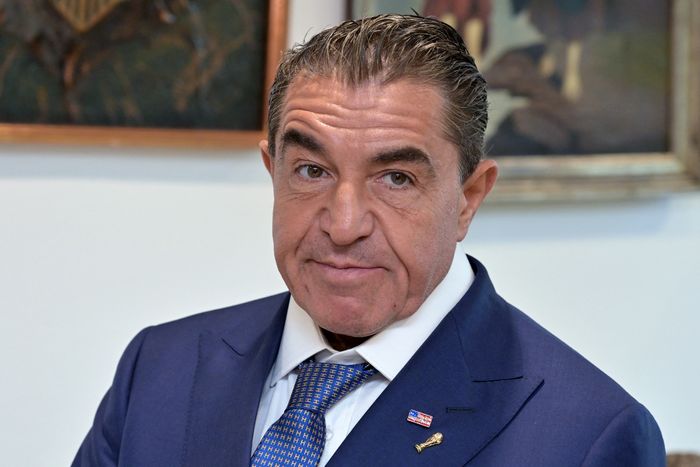
Paolo Zampolli, a Trump administration official who was appointed the special envoy for global partnerships.
Photo: Oliver Bunic/AFP/Getty Images
At the house on East 17th Street, a couple of freestanding apartment units appear to be available for short-term stays. The rooms, which are described in the 2011 Observer article as “keyed bedroom suites” with separate bathrooms and, in some cases, kitchenettes, were presumably for diplomatic guests. (One of the apartments, a fully furnished one-bedroom, can be seen in an old Zillow listing, although the unit is no longer available to rent.) But since at least October 2020, a studio in the building has been available for $200 a night and a one-bedroom for $250. Zampolli appears to be dividing his time between a residence in Washington, D.C., and missions to Dubai and Romania, and it doesn’t seem like he’s regularly on the premises, much less in New York. If true, this would violate Local Law 18, the short-term-rental law that took effect in 2023, better known as the anti-Airbnb law, which requires those renting a room for less than 30 days to be present while guests are staying over. The law also prohibits rentals from having their own locking doors or restricting access to the full residence, but both appear to be the case for the units in Zampolli’s house, based on videos filmed by guests. However, enforcement of the law remains limited — Zampolli has twice received complaints for operating an illegal hotel on the premises, according to NYC Department of Buildings records. However, the reports cited a lack of evidence, and the rentals are still available.
Perhaps Zampolli has largely escaped scrutiny because the audience for his short-term rentals appears to be quite narrow: Brazilian tourists. Short-term stays at his townhouse are advertised through vacationhub.vip (a website that abruptly went offline a couple of weeks ago) and on social-media platforms, where the account only posts in Portuguese. On paper, Vacation Hub USA-Brasil is a travel agency founded in 2012 and based in Harrison, New Jersey. The company is run by a Brazilian couple, Fabricio Pereira and Thais Navarro Leite da Silva.

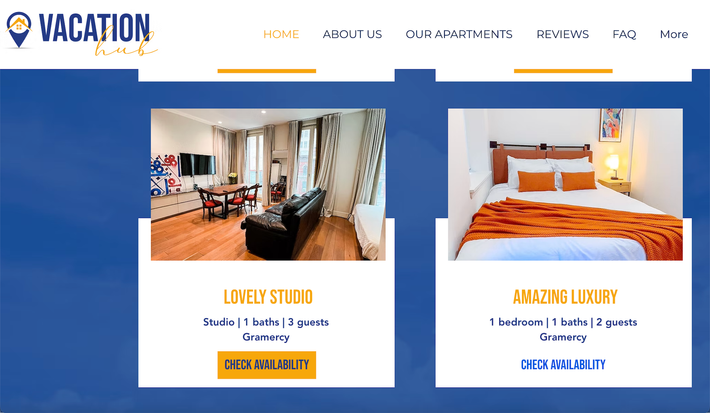
The two rentals shown here were listed on a Vacation Hub website that, since reporting on this story began, has been taken down. They show the studio and one-bedroom units that have been available for short-term nightly rates after the city’s Local Law 18 limiting short-term rentals was passed.
Photo: Vacation Hub
But why Brazil? Zampolli previously operated a satellite office of ID Model Management in São Paulo until 2008. His connection to Pereira, who moved to New York from São Paulo in 2002, goes back just as far, spanning more than two decades across multiple enterprises. According to Pereira’s recently deleted LinkedIn profile, he began as an executive assistant to Zampolli and worked his way up the ranks of the modeling agency. One former ID model and longtime associate of Zampolli and Pereira, who asked to remain anonymous because she fears for her safety, said that Pereira mostly worked as a driver for the models and a personal assistant who would do whatever Zampolli asked of him. He has long appeared Zelig-like alongside his boss at United Nations and Kennedy Center functions and on more informal trips abroad with Zampolli and his son.
But the public face of the Brazilian rental business is Pereira’s wife, Leite da Silva, a 33-year old woman who currently resides in São Paulo (like Pereira, she also recently deleted her personal LinkedIn page). She appears to be the de facto spokesperson for Vacation Hub USA, along with a Facebook page, Studio NYC Rental Official, which also advertises Zampolli’s apartments, and is the managing partner for Smart Hub, a co-working space in Brazil co-owned by Pereira. In online videos, Leite da Silva pitches the rentals herself, but only in Portuguese. In an April 2025 appearance on a Brazilian radio station, she even talked up the company’s 100 percent Portuguese-speaking customer service.
At least one of the units appears to be available on Airbnb; the “charming one-bedroom in the heart of Gramercy Park” is only bookable for 30 consecutive days, in keeping with the city’s laws. However, many of the reviews, including from last year, suggest that guests stayed for less than 30 days, including just a week or two. It’s not cheap; the price for a monthlong stay in August is now $11,300 — far above the median price for a one-bedroom rental in the neighborhood. The host for that apartment is listed as New York resident Regina Navarro, a Smart Hub employee living in Brazil who often appears in family photos with Leite da Silva.
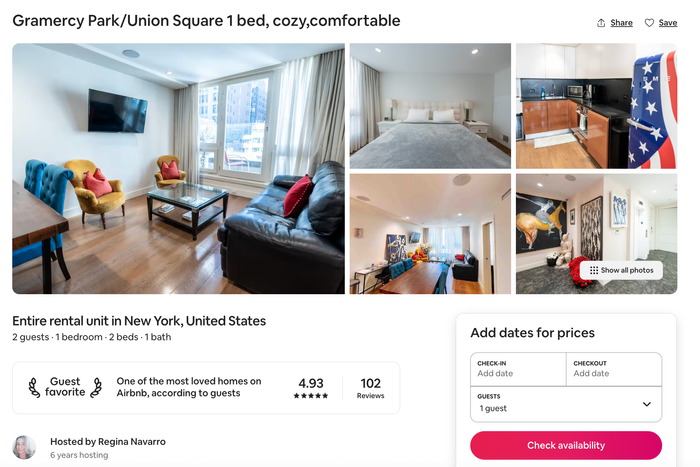
Zampolli told us that he is aware there are active AirBnb rentals in the building. This one appears to be one of the units in his townhouse. However he claimed to have no knowledge of the person listed as its host, Regina Navarro, who appears in family photographs with Thais Navarro, the wife of Zampolli’s longtime personal assistant, Fabricio Pereira.
Photo: Airbnb
Zampolli said that he is aware there are active Airbnb rentals at the townhouse in “compliance to the law of New York City, which has changed.” However, he claims to have no knowledge of Vacation Hub. “Fabricio works for me for three decades, but I am not familiar with this Brazilian advertising,” Zampolli said. As for Navarro, Zampolli responded, “Who is Regina? I do not know her.” He declined to say who he believed had been operating the Airbnb rental operation at his townhouse. Navarro did not respond to multiple requests for comment.
Shortly thereafter, Zampolli emailed to share that he is facing lawsuits in multiple countries and is under FBI investigation and would not comment further. Pereira also shared that he is under investigation by the FBI. (The FBI declined to share any details about these investigations.)
Even as the websites for the short-term rentals and the LinkedIn profiles of the operators are deleted from the web, Brazilian travel influencers with millions of followers promote them on Instagram and TikTok. Brazilian influencer Carolina Abriani (@caruabriani) shared her May stay at one of the apartments on her Instagram page but removed the video after being contacted by us (although her video publicizing the Vacation Hub listing remains on her YouTube page). Laura Peruchi, a Brazilian influencer based in New York, listed Zampolli’s apartment on her Portuguese-language travel site after being approached by Navarro in a Facebook group for Brazilian tourists. After being contacted for this story, however, it was removed from her site, which she said was a matter of routine maintenance since she had moved away from publishing New York travel tips for a Brazilian audience. In an October 2024 video, influencer Andre Oliveira (@seliganoroteiro) waves viewers into the foyer of Zampolli’s townhouse; bounces on the bed; and talks up the full kitchen, Portuguese customer service, and convenient subway access of this “perfect accommodation with an affordable price.” The accompanying caption promotes rates as low as $160 per night — before their exclusive discount code — which they say can even be paid in Brazilian real.
In any currency, the extra income may come in handy for Zampolli. The source of his wealth has been a mystery ever since he traded a career in fashion and real estate for diplomacy; ambassadors to the United Nations earn under $200,000 a year. While Zampolli is not listed in the business documents for Vacation Hub, he is identified as the CEO of Argentavis Holdings Corp, established in 2009. (The business paperwork also lists Pereira as an employee.) In a phone interview, Zampolli said that Argentavis has no connection to the townhouse, and he later amended his comment to say it didn’t exist. It’s not clear exactly what Argentavis does; it seems to be a catchall operation for any number of Zampolli’s hard-to-explain initiatives. Last year, the company imported a dozen 1,000-pound bronze sculptures from China to Zampolli’s home address. Their purpose was unclear, but earlier this year, Zampolli made a show of privately transporting a bronze replica of the 7,100-pound Wall Street bull to USA House, a diplomatic pop-up celebrating the United States’ 250th anniversary at the World Economic Forum in Davos, Switzerland, which Zampolli is heavily involved in. He continues to have his hand in many pots. Over the last two decades, he has promoted a drone-defense company, AI-powered COVID detection, and facial-recognition technology, which is installed at the entrance of his townhouse. Zampolli has also championed businesses including satellite-channel FashionTV and sustainable-flower brand Rose Forever without disclosing his financial ties to them.
But are any of these hustles profitable? Argentavis’s earnings remain as opaque as his current salary as special envoy. His federal salary, if he receives one, is a mystery. A July 2025 congressional report lists the title and income of all White House personnel. Joseph Kellogg, U.S. special envoy for Ukraine and Russia, earns $195,200 per year, while Steve Witkoff draws no salary in his role as special assistant to the president and special envoy for peace missions. Zampolli, who received his appointment in March 2025, isn’t listed at all.