


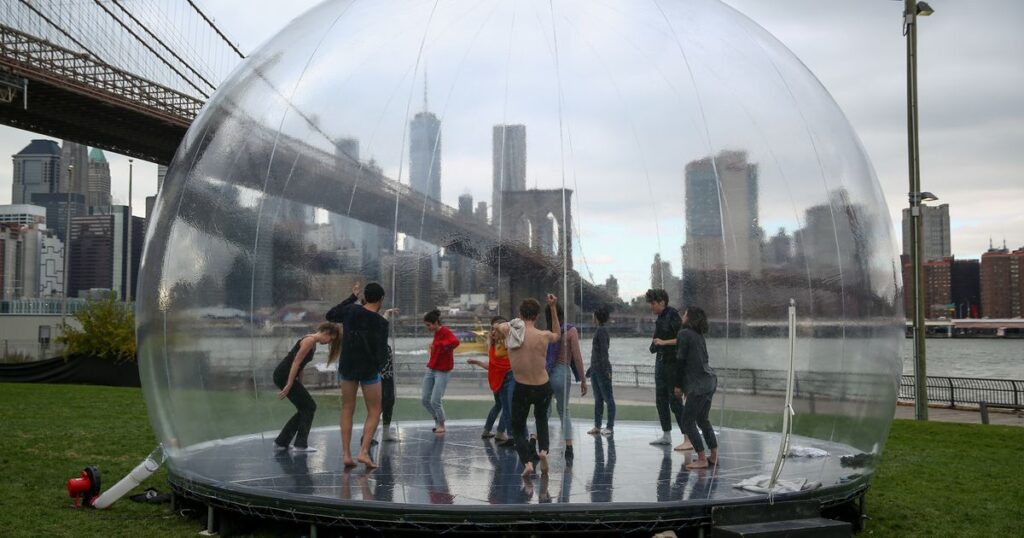
François Dallegret’s The Environment-Bubble, realized in Central Park for Performa 17.
Photo: Paula Court/Courtesy of Performa.
Twenty years ago, the curator and art historian RoseLee Goldberg began to think about what it might mean to “frame” a work of performance art. She had moved from London in 1975 to a loft on Mercer Street, just across from Joan Jonas’s studio and up the street from Donald Judd and Nam June Paik’s — all artists who blended art into their surroundings. So when Goldberg organized the first edition of her biennial dedicated to performance art, Performa, in 2005, she made the city itself its stage.
Goldberg, who is 79, has since scouted hundreds of sites with artists to choose what she calls “the perfect frame” for their work. Among the earliest was the Noho McDonald’s, where artist Christian Holstad installed a vintage jukebox that played Will Oldham, and the Slipper Room burlesque bar, where artist Francis Alÿs had a dancer tease her clothes back on. The venues took even more experimental turns as the years went on. In 2013, guests derobed at the Russian and Turkish baths to watch Rashid Johnson’s steamy rendition of Amiri Baraka’s play Dutchman, which the artist just revived again for the latest edition of Performa in November. Then, in 2015, the artist Robin Rhode chose Times Square on a Saturday night as the site for his interpretation of a slow-motion, atonal Arnold Schönberg opera. Instead of a moonlit forest, he used “the vertical architecture of New York itself” as the set, he has said. “Times Square, with its simultaneity of movement, light, and sound, resonated profoundly with Schoenberg’s fractured tonality and heightened emotional register.”
On the occasion of Performa’s 20th anniversary, we spoke to Goldberg about commissioning art in unconventional places, and how performance art’s history has been woven into the geography of New York for decades.
From the beginning, Performa has been inspired by the city. How did you take advantage of your surroundings during the inaugural biennial?
The city of New York has been this centerpiece of live performance for artists for the last 80 years, going back to the early days of “happenings.” The city is already the entire history of art and culture. We just endlessly follow this tour back and forth, up and downtown, across into Brooklyn and across the east and west. The geography is marked by different cultural places and landmarks. We underscore that even further with the biennial. We started right from the beginning with this idea of collaboration, of working with as many institutions as we could get to in time, because we put the first one together very quickly, in six months. I went to everybody I’d known so long in New York — the Kitchen to Artist Space to Art in General to the Guggenheim to MoMA — to sort of nudge it all into November so that we could really conjure a new idea about how to use the city as a stage.
I see it as a kind of radical urbanism. Events can change the feel of the street or a neighborhood. So we were constantly programming to remind people about the vitality and the richness of this city and how it all threads together and sustains us. Having watched it for all these different decades, to see it turn from the ‘70s, when it was $200 a month for a 2,000-square-foot loft, into the ‘80s, where suddenly the prices went up three or five times, and it’s the Reagan and Thatcher ‘80s. And until the ‘90s there was no Chelsea. We see how those parts of the city shift because the art world goes and then real estate follows.
How do you find what you call “the perfect frame” for an artist?
We see what the work is going to be about and we think, Okay, where do we put this? What’s the frame for that work? So putting Tschabalala Self in the band shell in Harlem, or Shikeith on the beach at Far Rockaway, or Harlem parish, where we worked with Julie Mehretu, or the Léman Ballroom, which was absolutely gorgeous for Julien Creuzet last year. We’re endlessly discovering spaces people had no idea existed. We make it a part of the pleasure of discovery during the biennial.
Each piece has a wonderful story. The record was Tarik Kiswanson, one of the artists we worked with a few biennials back, I think we showed him 30 different spaces. And he actually went back to the very first place we showed him, which was Custom House downtown, in the same building with the American Indian Museum. It was a beautiful, beautiful space. When you have something you want to put in the frame it has to enhance the work and somehow, complement it and highlight the work, rather than subdue it. Most theaters actually have a way of subduing the work. Some festivals use the same space every day — you know exactly what you’re getting — whereas we were looking for spaces that just give another, entirely different quality to the work. We spent the last six months looking for a space for one young artist, Diane Severin Nguyen. She wanted it to look like a sound studio, somewhere that a band was being recorded, so that took a while. We finally got the BRIC arts center in Brooklyn. We could make things easier for ourselves by taking the same space every year, but we really look to follow the imagination of the artist.
Are the spaces usually chosen by artists or curators? I’d love to know how some of these more unusual venues come to be, such as Rashid Johnson’s performance inside the East Village baths.
We essentially find the spaces for the artist. With Rashid, that was his genius idea. I’d been saying to him for years, “I know you don’t do live performance, but if you ever do, please let me know.” Three years later, after me bringing it up every time I met him, he suddenly said, “Oh, I know what I want to do: Dutchman at the baths on 10th Street,” and I was like, “Great, let’s go.” It was because he had seen a version of Dutchman a couple years earlier, but then told me that he has this whole relationship with bathhouses from when he was a student in Chicago, and how long ago he would sit there thinking, Wouldn’t this be a nice place for theater?
Did you ever try to reactivate those old spaces that performance artists were using in, say, the 1970s?
Absolutely. In fact, Mike Kelley’s was such a memorable piece. He was determined that we’d go back to Judson Church for his 2009 performance of a teenage psychodrama. In the ‘70s, Yvonne Rainer and Trisha Brown and that whole generation was fixated on the church, so that was very important.
I hear the government shutdown caused some problems this year. The Lithuanian artist Lina Lapelytė was supposed to have her performance — which involves children walking around making animal sounds — in Federal Hall. Did that happen?
Lina loved this idea of all the conversations that would have gone on in Federal Hall, which is where George Washington’s presidency was inaugurated. She was fascinated by this idea of free speech, and being in the place where the constitution was put into the hands of the first president of the United States. It just seems so interesting and ironic to do something where kids are all using the language of animals and communicating in a completely different way. So it seems a lovely reference to what’s going on and what the piece is about. It’s a pity, but we’ve landed another space, Harlem Parish.
Is there a venue on your bucket list?
I enjoy using spaces that reveal New York City’s history in extraordinary ways and that open new places to the public. The city feels even richer than ever when we get to know the architectural gems that were designed to give authority to the new world and that are still in use. City Hall, described as a fantastic mix of “French Renaissance” on the outside and “American Georgian” inside, has been in constant use since it opened in 1812 as the house of city government. It is precisely because it is a beacon of civic architectural presence, but which is closed to the public, that makes me eager to get inside.